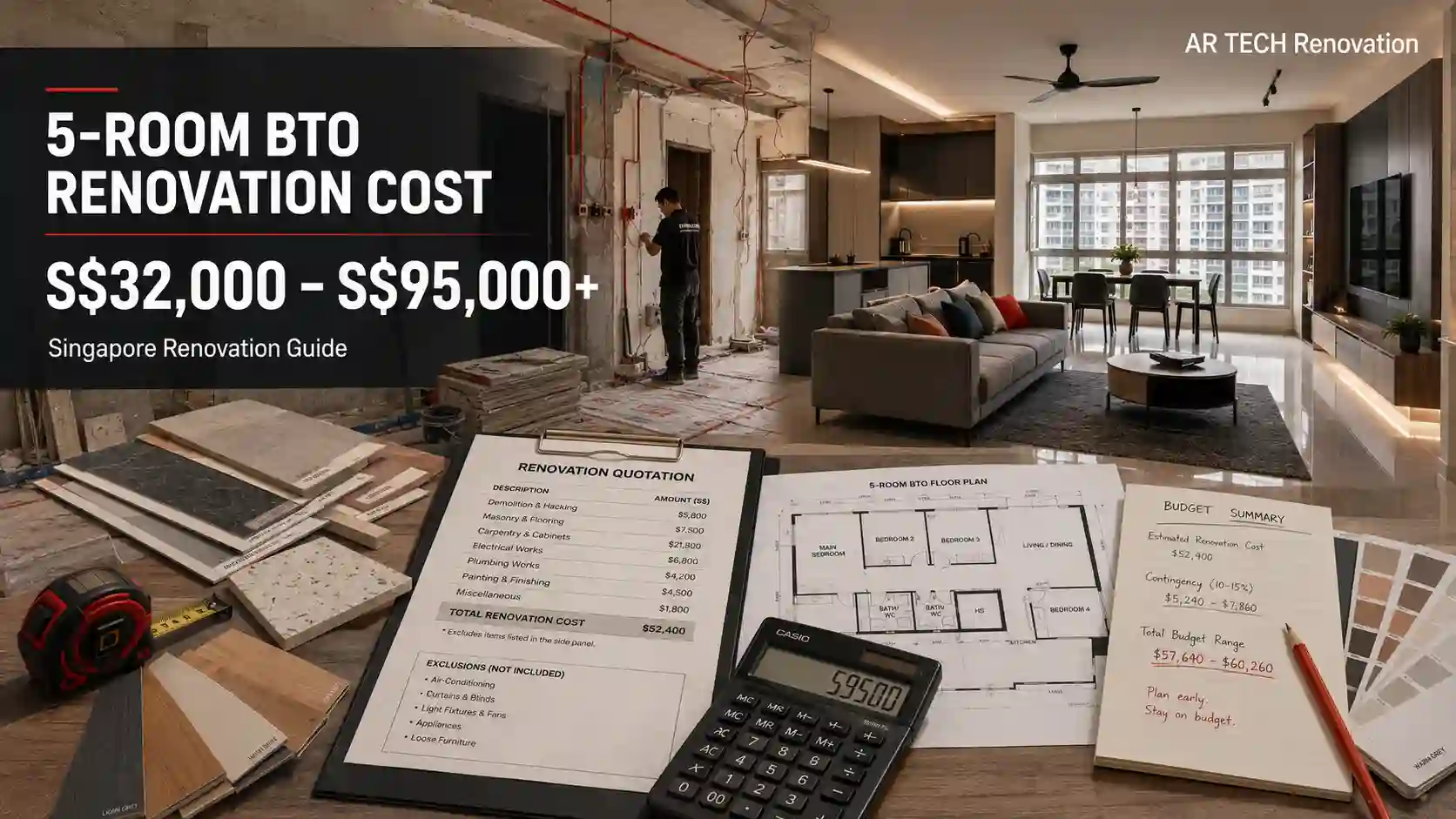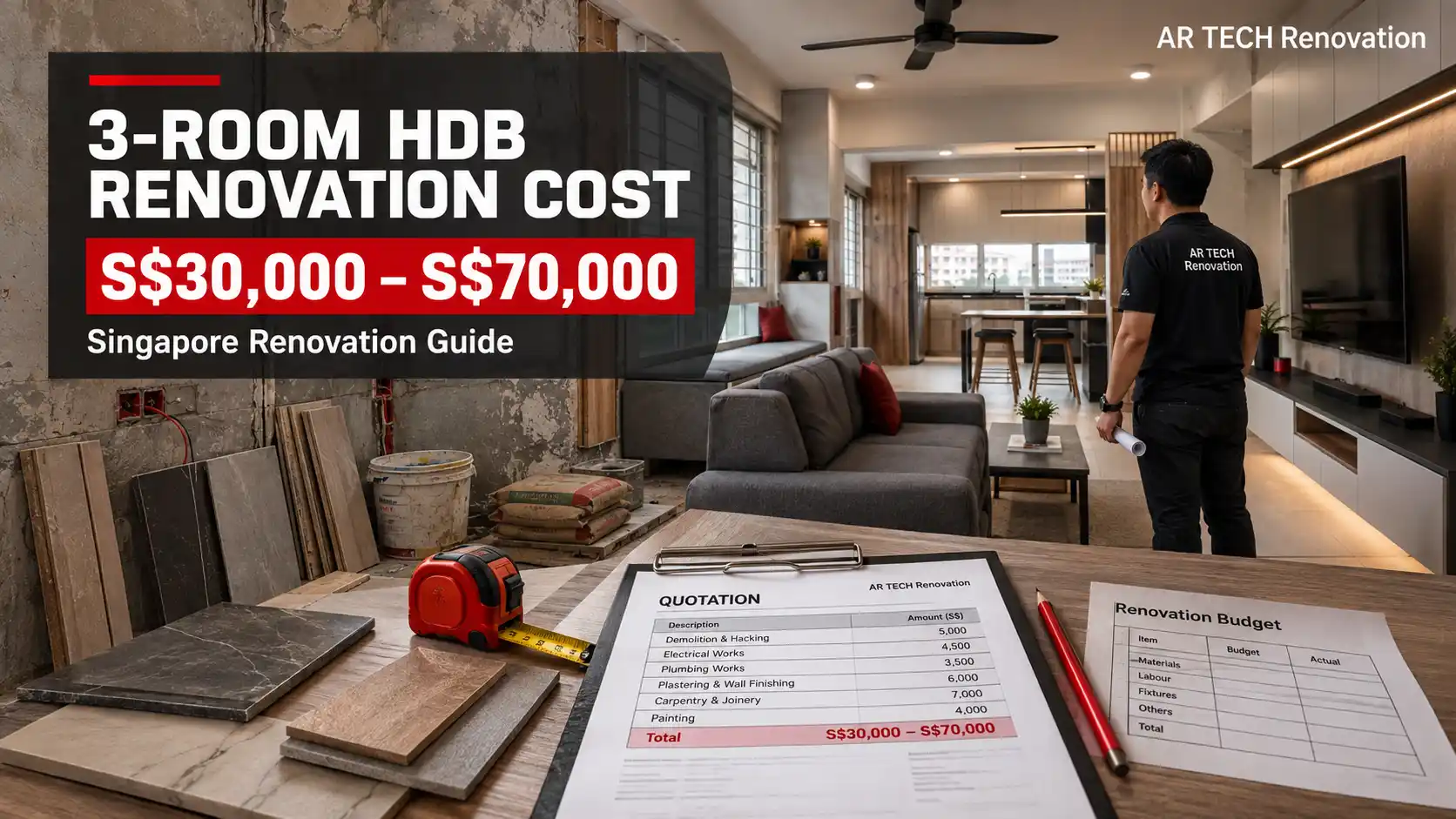
Most homeowners in Singapore feel lost when they see their first renovation quote. The numbers look confusing. Some items seem too cheap. Others feel shockingly high. You don’t know what’s fair – and that worry is completely valid.
This happens because renovation pricing in Singapore depends on many moving parts. Your property type matters. So does the age of your home, the scope of work, and your material choices. Ten years in this trade have shown me how quickly budgets spiral when homeowners go in unprepared.
By the end of this article, you’ll know the real renovation cost in Singapore for every property type – complementing our complete guide to home renovation in Singapore with the specific numbers and budgeting insights you need. You’ll understand what drives prices up, where hidden costs hide, and how to budget without getting burned.
Cost Breakdown by Property Type
Renovation costs in Singapore vary widely based on the property you own. Understanding the differences between HDB and condo renovation is essential, since a small BTO flat and a landed home sit at completely opposite ends of the price scale. Knowing your property type is the first step in planning a realistic home renovation budget in Singapore.
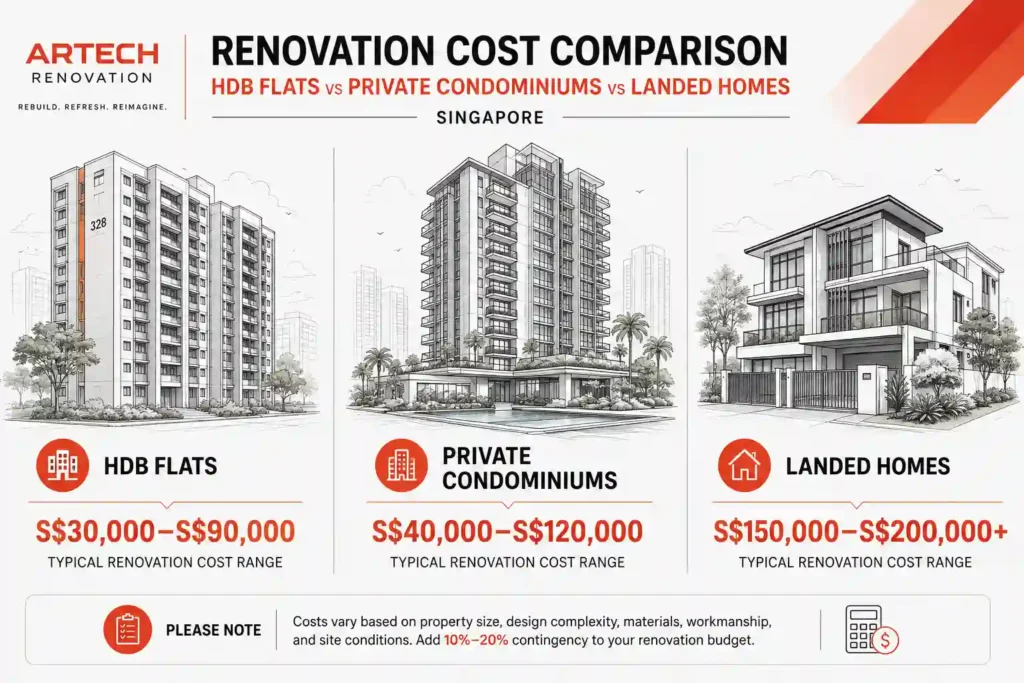
Here’s the overall range to expect:
- HDB Flats: S$30,000 – S$90,000
- Private Condominiums: S$40,000 – S$120,000
- Landed Homes: S$150,000 – S$200,000+
These are full renovation ranges. Partial renovations cost less. Luxury finishes push costs higher.
HDB Flats (BTO vs. Resale)
HDB flats are the most common renovation project in Singapore. Costs depend heavily on whether your unit is a BTO or resale flat. Resale flats almost always cost more to renovate.
| Flat Type | Size | BTO Estimated Cost | Resale Estimated Cost |
| 3-Room | ~65 sqm | S$15,000 – S$45,000 | S$45,000 – S$65,000 |
| 4-Room | ~90 sqm | S$20,000 – S$60,000 | S$60,000 – S$81,000 |
| 5-Room | ~110 sqm | S$25,000 – S$70,000 | S$70,000 – S$100,000 |
| Executive / Maisonette | Varies | S$40,000 – S$80,000 | S$90,000 – S$120,000+ |
BTO flats are newer. They need less hacking and fewer repairs. Resale flats often require full rewiring, tile hacking, and waterproofing. That extra work adds up fast.
Private Condominiums
Condo renovation costs depend on unit size and the condo’s MCST rules. Most condos restrict work hours, require deposits, and limit noise. These rules add both time and cost to your project.
- Small Condo (under 800 sq ft): S$30,000 – S$90,000
- Medium Condo (800-1,200 sq ft): S$40,000 – S$120,000
- Large Condo (over 1,200 sq ft): S$50,000 – S$150,000+
Condo owners also need to factor in MCST management deposits. These deposits range from S$1,000 to S$3,000. They’re refunded after renovation, but you need that cash upfront.
Landed Homes
Landed property renovation is the most complex and expensive category. These homes are larger, older, and often need significant structural work. Most landed renovations start at S$150,000 and can easily exceed S$200,000.
The size of the land, the age of the property, and the number of floors all affect the final cost. Don’t budget for a landed home renovation based on HDB price guides. They don’t apply.
Major Cost Drivers
Four trades make up the bulk of any renovation bill in Singapore. Understanding each one helps you know where your money goes and where you can adjust.
Carpentry (S$20,000 – S$40,000+)
Carpentry is the single biggest cost in most Singapore renovations. It typically takes up 30% to 45% of the total renovation budget. Custom kitchen cabinets, built-in wardrobes, TV feature walls, and study shelving all fall under this category.
Custom kitchen cabinets and built-in wardrobes alone can cost S$12,000 to S$28,000. That number climbs when you choose premium materials, soft-close fittings, or complex designs. Customers struggle with this because carpentry quotes look reasonable per item. But the total adds up quickly across the whole home.
You can manage this by limiting carpentry to rooms where built-ins genuinely add value. Don’t build something just because the space allows it.
Masonry & Flooring (S$5,000 – S$15,000+)
Masonry and tiling work typically costs S$900 to S$3,900 per area. That includes hacking old tiles, laying new ones, grouting, and waterproofing wet areas. For a full flat, the total often lands between S$5,000 and S$15,000.
Resale flats need more masonry work. Old tiles must be hacked before new ones go down. That adds labour time and debris removal costs. Some homeowners skip full tile hacking by using vinyl overlay instead. This can reduce costs significantly.
M&E / Electrical & Plumbing (S$4,000 – S$12,000)
Electrical rewiring costs S$3,000 to S$8,000 for most HDB flats. Plumbing changes add more. Together, the M&E (mechanical and electrical) scope often reaches S$4,000 to S$12,000 in total.
This problem happens when resale flats have outdated wiring. Old electrical systems can’t handle modern appliances safely. Skipping rewiring to save money creates fire risks. Don’t cut corners here.
Hacking & Demolition (S$3,000 – S$8,000)
Hacking costs S$400 to S$900 per area in Singapore. For a full 4-room resale flat, complete hacking can reach S$3,000 to S$5,500. Larger flats and more complex demolition work push this higher.
This cost catches many homeowners off guard. It’s not visible in the finished home. But it’s a real and necessary expense. Skipping proper demolition leads to poor finish quality and structural problems later.
Hidden Costs to Keep in Mind
Several renovation costs don’t appear in most initial quotations. These hidden expenses catch homeowners by surprise mid-project. Knowing them now protects your budget later.
Defects Rectification
Resale flat buyers often discover defects only after renovation starts. Hidden water damage, weak structures, and concealed wall cracks are common. Fixing these problems isn’t optional. They add unplanned costs quickly.
Set aside at least 10% of your total renovation budget for defects. This is especially important for older resale flats. The older the flat, the higher the risk.
MCST / HDB Permits & Insurance
HDB and condo renovations require permits and refundable deposits. HDB requires you to submit renovation plans before starting. Condos require MCST approval and a management deposit of S$1,000 to S$3,000.
You also need workmen’s compensation insurance before work begins. Some contractors include this. Others don’t. Check your renovation quotation carefully before signing.
Appliances & Loose Furniture
Most renovation quotes don’t include appliances or loose furniture. Curtains, beds, sofas, dining tables, refrigerators, washing machines, and smart lighting all need a separate budget. Many homeowners forget this until after they’ve spent their full renovation budget.
This is a common gap. Budget at least S$10,000 to S$20,000 for appliances and furniture in a standard HDB flat. Premium items cost significantly more.
Temporary Accommodation
You may need to rent alternative accommodation during renovation. Full renovations in Singapore typically take 6 to 12 weeks. If you can’t stay in the unit during work, rental costs will add to your total expenses.
Short-term rentals in Singapore aren’t cheap. Factor this into your overall housing cost during the renovation period.
Critical Budgeting Blind Spots
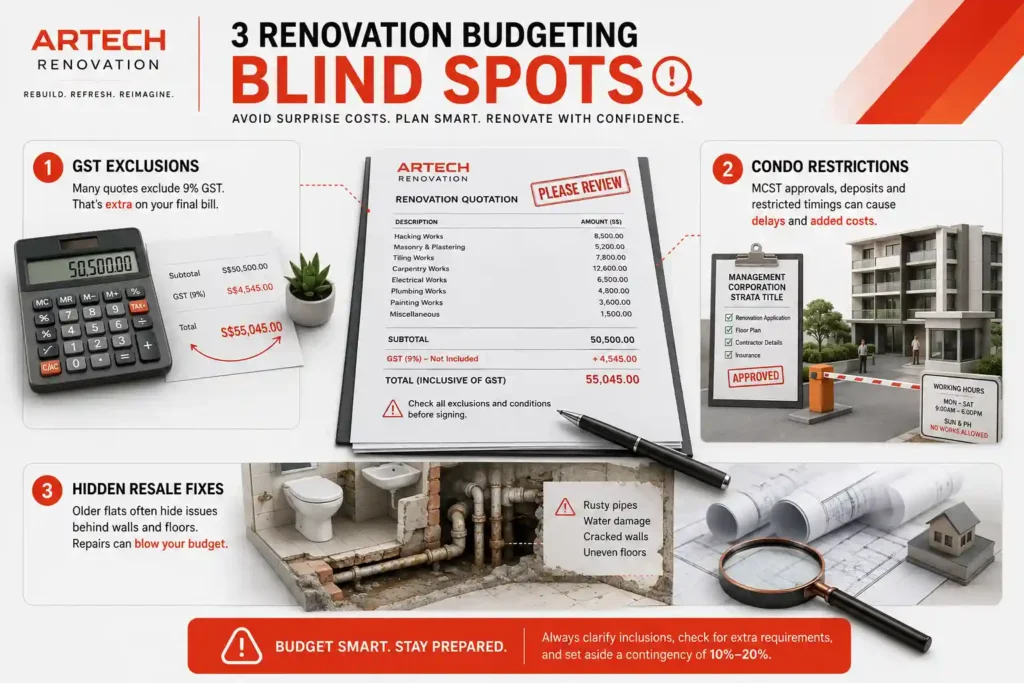
Many homeowners get a shock mid-renovation because of three specific oversights. These aren’t hidden in the fine print. They’re just easy to overlook when you’re excited about your new home.
GST Exclusions
Always check whether GST is included in your renovation quotation. Some contractors quote prices before GST. Others include it. If it’s excluded, add 9% to every quoted price. On a S$60,000 renovation, that’s an extra S$5,400.
Ask this question before you compare quotes. A lower quote without GST may actually cost more than a slightly higher GST-inclusive one.
Condo Restrictions
Condo MCST rules can increase your renovation timeline and cost. Strict work-hour limits slow down the project. Some condos restrict wet work to specific days. Material delivery may require prior approval. These restrictions add contractor man-days and cost.
Check the MCST handbook for your condo before starting. Your contractor should know these rules. If they don’t ask about them, that’s a red flag.
Hidden Resale Fixes
Resale flats often have problems that only appear after hacking begins. Corroded pipes, wet walls, weak floor screeds, and outdated circuit breakers are common discoveries. These problems must be fixed. They aren’t optional, and they aren’t in the original quote.
This is the biggest reason resale flat renovations run over budget. Expect surprises. Plan for them financially.
Practical Ways to Reduce Expenses
You can reduce your renovation cost without sacrificing quality. The key is making smart trade-offs early. Don’t try to cut costs after the work has already started.
Opt for Vinyl Overlay
Vinyl plank overlay goes directly over existing tiles. This skips the cost of tile hacking, debris removal, and relaying new tiles. It’s a practical option for homeowners who want a clean floor look without the heavy cost.
Vinyl flooring has improved significantly. Modern vinyl planks look realistic and are water-resistant. For a full flat, this choice can save S$3,000 to S$8,000 compared to full tile replacement.
Limit Built-in Carpentry
Every additional built-in unit adds thousands to your bill. Ask yourself whether you truly need full built-in storage in every room. Freestanding furniture from local retailers can fill the same role at a fraction of the price.
Focus built-in carpentry on the kitchen and master bedroom. These areas benefit most from custom storage. Other rooms can use quality loose furniture instead.
Choose a Simpler Aesthetic
Complex design concepts cost significantly more to execute. Curves, recessed lighting in every corner, multi-level ceilings, and feature walls all add to your carpentry and electrical bill. A clean, minimal design often looks better and costs far less.
This problem happens when homeowners fall in love with design concepts from showrooms or social media. Those spaces have unlimited budgets. Most homeowners don’t. Simplicity saves money and ages better.
Why Renovation Costs Increased in 2026
Renovation costs in Singapore are noticeably higher in 2026 than they were a few years ago. Several factors have combined to push prices up across all property types.
Material Costs Have Increased
Building material prices have risen significantly since 2022. Tiles, timber, steel, and paint all cost more today than before. Global supply issues and increased demand pushed prices up and they haven’t fully come back down.
Labour Costs Have Gone Up
Skilled renovation workers now command higher daily rates. Foreign worker levy changes and post-pandemic labour market shifts have made skilled trades more expensive. Tilers, electricians, and carpenters all earn more per day than before.
Supply Chain Delays
Delays in material delivery extend project timelines. A longer project means more contractor visits and more man-days charged. Imported tiles, custom cabinets, and specialty fittings often face 4 to 8 week wait times. This adds indirect cost to every project.
Condo and Landed Projects
Condo and landed home renovations have absorbed the steepest cost increases. These projects require more skilled labour, more materials, and longer timelines. MCST restrictions add further inefficiency. Expect current condo and landed renovation prices to reflect these combined pressures.
What You’re Actually Paying For
Your renovation budget covers labour, materials, project management, and logistics. Here’s a simple breakdown of where the money typically goes on a standard HDB renovation:
| Cost Category | Typical Share of Budget |
| Carpentry (cabinets, wardrobes, features) | 30% – 45% |
| Masonry & Tiling | 10% – 20% |
| Electrical & Plumbing | 8% – 15% |
| Hacking & Demolition | 5% – 10% |
| Painting & Plastering | 4% – 8% |
| Haulage & Debris Removal | 2% – 4% |
| Permits, Deposits & Insurance | 2% – 5% |
| Contingency | 10% (recommended) |
Every project is different. These percentages shift based on your scope. But they give you a realistic picture of where money flows in a typical renovation.
Room-by-Room Cost Benchmarks (HDB, 2026)
Here’s what individual rooms typically cost to renovate in a standard HDB flat:
| Room | Estimated Cost (2026) |
| Kitchen (full renovation) | S$8,000 – S$20,000 |
| Master Bedroom (carpentry + flooring) | S$6,000 – S$15,000 |
| Common Bathroom | S$5,000 – S$10,000 |
| Master Bathroom | S$6,000 – S$12,000 |
| Living Room (feature wall + flooring) | S$5,000 – S$12,000 |
| Common Bedroom | S$3,000 – S$7,000 |
| Study Room | S$2,000 – S$5,000 |
These are benchmarks, not fixed prices. Your material choices, flat size, and scope of work will affect the final numbers. Use these figures to check whether a quotation is reasonable.
Resale vs BTO: Why the Price Gap Exists
Resale flats cost 20% to 40% more to renovate than BTO flats of the same size. This isn’t about taste. It’s about the condition of the property and the work required to bring it to a liveable standard.
BTO flats are brand new. The structure is clean. Tiles are already laid. Electrical points are new. You’re renovating on a blank slate. The main costs are carpentry, flooring upgrades, and paint.
Resale flats carry years of wear. Old tiles must be hacked. Waterproofing often fails in bathrooms and kitchens. Electrical wiring may be outdated or insufficient for modern appliances. Plumbing may need partial or full replacement. Each of these adds cost before your actual renovation even begins.
A resale 4-room flat that looks perfectly fine during viewing can reveal thousands of dollars in hidden problems after hacking starts. This is why experienced contractors always recommend a contingency budget for resale renovations.
Understanding Budget Tiers
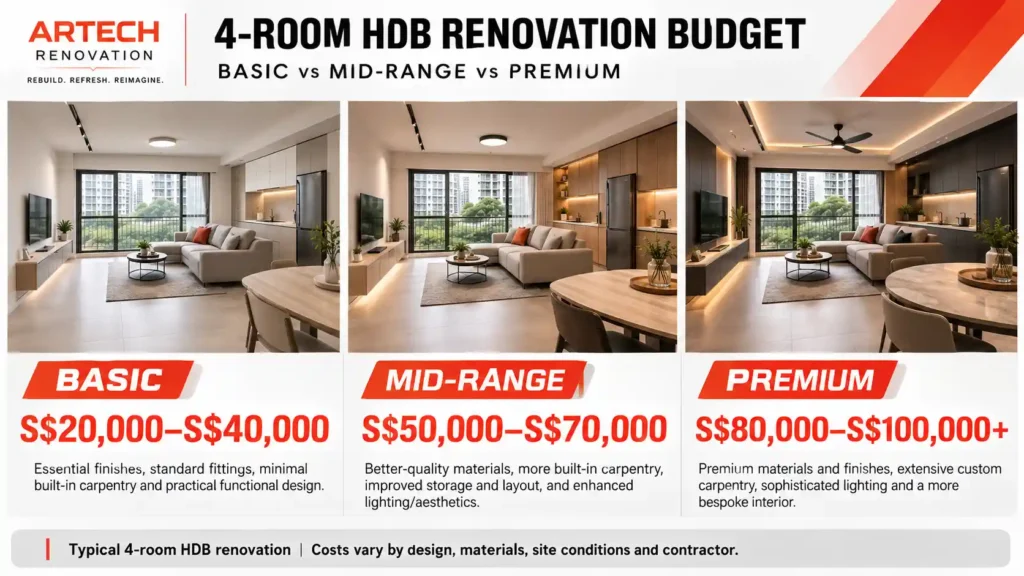
Singapore renovation budgets generally fall into three tiers. Knowing which tier fits your goals helps you plan realistically and avoid disappointment.
Basic Renovation Budget
A basic renovation covers functional improvements with standard materials. This tier focuses on what you need rather than what you want. Think flat-pack carpentry, basic tiles, and standard electrical points.
For a 4-room BTO flat, a basic renovation can land between S$20,000 and S$40,000. You won’t get high-end finishes. But the flat will be clean, functional, and comfortable.
Mid-Range Renovation Budget
A mid-range budget gives you better materials and more custom work. This is the most common tier among Singapore homeowners. It balances quality with cost. You can expect custom carpentry, imported tiles, and quality electrical fittings.
For a 4-room HDB flat, mid-range renovations typically cost S$50,000 to S$70,000. This includes a full kitchen, two bathrooms, carpentry for the living room and bedrooms, and decent flooring throughout.
Premium Renovation Budget
A premium renovation uses high-end materials and fully custom designs. Everything is made to order. Materials are imported or specialty-grade. Finishes are precise. Timelines are longer.
For a 4-room HDB flat, premium renovations can reach S$80,000 to S$100,000 or more. For condos and landed homes, there’s no ceiling. The budget depends entirely on your choices.
What Most Homeowners Only Learn Too Late
These four realities surprise homeowners every single day. Knowing them before you start saves money, time, and frustration.
Renovation Quotes Rarely Include Everything
A renovation quote is not a fixed final cost. Most standard quotes cover core trades only. GST, permits, haulage, debris removal, and defect rectification are often excluded. Some contractors also exclude touch-up painting, light fixtures, and door handles.
Read every line of your quotation. Ask specifically what is not included. A detailed and transparent quote is one of the best signs of a reliable contractor – and knowing how to choose a renovation contractor in Singapore will help you spot the difference early.
Cheap Quotations Often Lead to Costly Variations
A low quote gets you started. Variation orders cost you more later. Contractors who quote low often add variation charges mid-project. These are extra costs for changes or items not included in the original scope. This problem happens when the original quote is vague or incomplete.
Customers struggle with this because they feel committed once work has started. The best protection is a detailed scope of work from the beginning. Never sign a quote that lacks clear line items.
Custom Designs Increase Costs Faster Than Expected
Every custom element adds more cost than most homeowners expect. A custom curve in the ceiling, a unique feature wall pattern, or a specific imported tile all require more time, more skill, and more money. This problem happens when homeowners finalise designs without understanding the cost implications.
Before approving any custom design element, ask your contractor for the cost first. Designers often show beautiful concepts. Builders give you the real price.
Delays Can Increase Your Overall Renovation Budget
A delayed renovation can increase your total cost in multiple ways. Rental costs extend. Contractor standby rates apply. Material price increases may affect pending orders. Some homeowners also need to make changes mid-project when they see the actual space taking shape. Every change costs money.
Set a realistic timeline with your contractor before work begins. Build buffer time in. Don’t plan your move-in date for the same week the renovation ends.
Frequently Asked Questions
What is the average renovation cost in Singapore?
The average home renovation cost in Singapore ranges from S$30,000 to S$90,000 for HDB flats. Condos typically range from S$40,000 to S$120,000. Landed homes often start at S$150,000. The final number depends on your property type, its age, the scope of work, and your material choices.
How much does it cost to renovate an HDB flat in Singapore?
HDB renovation costs range from S$15,000 for a basic 3-room BTO flat to over S$100,000 for an executive resale unit. Most 4-room HDB flat renovations land between S$40,000 and S$70,000. Resale flats cost more than BTOs due to additional hacking, rewiring, and waterproofing work.
How much does a condo renovation cost in Singapore?
Condo renovation in Singapore typically costs S$30,000 to S$150,000 or more. Small units under 800 sq ft may come in at S$30,000 to S$90,000. Larger condos above 1,200 sq ft often exceed S$100,000. MCST restrictions and management deposits add to the total cost and timeline.
How much does it cost to renovate a landed home in Singapore?
Landed home renovation in Singapore usually starts at S$150,000 and can exceed S$200,000. The size, age, and structural condition of the property affect the final cost. Older landed properties often need significant waterproofing, structural repair, and full electrical rewiring before cosmetic work begins.
Why is a resale HDB more expensive to renovate than a BTO?
Resale HDB flats require more preparatory work before any renovation begins. Old tiles must be hacked. Electrical wiring is often outdated. Waterproofing in bathrooms and kitchens frequently fails over time. These extra steps add S$10,000 to S$30,000 or more to the renovation cost compared to a new BTO flat.
What is the most expensive part of renovating a house?
Carpentry is the most expensive trade in most Singapore renovations. It typically accounts for 30% to 45% of the total renovation budget. Custom kitchen cabinets, wardrobes, and feature walls drive this cost up quickly. Managing your carpentry scope is the most effective way to control total renovation expenses.
Is S$30,000 enough to renovate an HDB flat?
S$30,000 can cover a basic renovation for a 3-room BTO flat. For a 4-room or 5-room flat, S$30,000 will only stretch to partial renovation. For resale flats, S$30,000 is rarely enough to cover the full scope of work. A realistic budget for a complete 4-room resale renovation starts at S$60,000.
How much contingency budget should I set aside for a Singapore renovation?
Set aside at least 10% of your total renovation budget as contingency. For resale flats, 15% is a safer buffer. This reserve covers unexpected defects, mid-project design changes, and price variations for materials. Contingency savings protect you from being forced into poor decisions when costs arise.
Should I hire an interior designer or go directly to a renovation contractor?
A renovation contractor is usually more cost-effective for straightforward renovation work. Interior designers add value for complex design concepts, space planning, and project coordination. But they also add professional fees of 10% to 20% of the total budget. For homeowners with a clear vision, going directly to a contractor saves significant money.
How long does an HDB renovation usually take?
A full HDB renovation typically takes 8 to 12 weeks. Simpler scopes may finish in 6 weeks. Complex resale renovations can take 14 weeks or longer. Permit processing, material delivery delays, and condo MCST restrictions can all extend the timeline. Always plan buffer time before your planned move-in date.
Can you renovate a bathroom for S$10,000?
Yes, a standard bathroom renovation in Singapore can be done for S$8,000 to S$12,000. This covers tile hacking, new tiles, waterproofing, new sanitary fittings, and basic electrical points. Premium fittings, custom vanities, and imported tiles will push the cost higher. A realistic budget ensures quality workmanship without unnecessary compromise.
Can I use CPF to pay for renovation?
CPF Ordinary Account funds generally cannot be used to pay for renovation directly. However, you can apply for a renovation loan from HDB or a bank. These loans allow you to borrow and repay using your monthly income or CPF for eligible housing loan repayments. Check the HDB website or your bank for current eligibility conditions.
Conclusion
Home renovation costs in Singapore vary based on property type, flat size, age, and the scope of work you choose. BTO flats start at S$15,000 for basic renovations. Resale flats typically need S$45,000 or more. Condos and landed homes carry higher costs driven by size, restrictions, and complexity. The biggest cost drivers are carpentry, masonry, electrical work, and hacking. Hidden costs like GST, permits, deposits, and contingency expenses can add 15% to 25% on top of any quoted price.
Planning a renovation without understanding these numbers is the fastest way to blow your budget. The homeowners who manage renovation costs well are those who ask detailed questions early, read every line of their quotation, and budget for surprises. They don’t just look for the cheapest quote. They look for the most transparent and complete one.
We at AR Tech Renovation have guided homeowners through renovation projects across all property types for over a decade. We know where costs hide, why budgets blow out, and how to keep your project on track from day one. If you’re planning a renovation and want a detailed, honest quotation with no surprises, we’re ready to help you get it right from the start. Reach out to us today for a free consultation.