Hiring the wrong renovation contractor can cost you tens of thousands of dollars. Many Singapore homeowners sign contracts too quickly. They end up with delays, poor workmanship, and no way to get their money back. It’s a stressful situation – and it happens more often than you’d think.
Choosing the right contractor takes more than a Google search. You need to check credentials, review real work, and ask the right questions. Experienced contractors leave a clear paper trail of completed projects, proper licenses, and happy clients.
This guide walks you through every key step. You’ll learn how to verify licenses, compare quotes, spot red flags, and sign a contract that protects you. By the end, you’ll know exactly how to choose a renovation contractor in Singapore with confidence.
Understand Your Renovation Needs Before Hiring
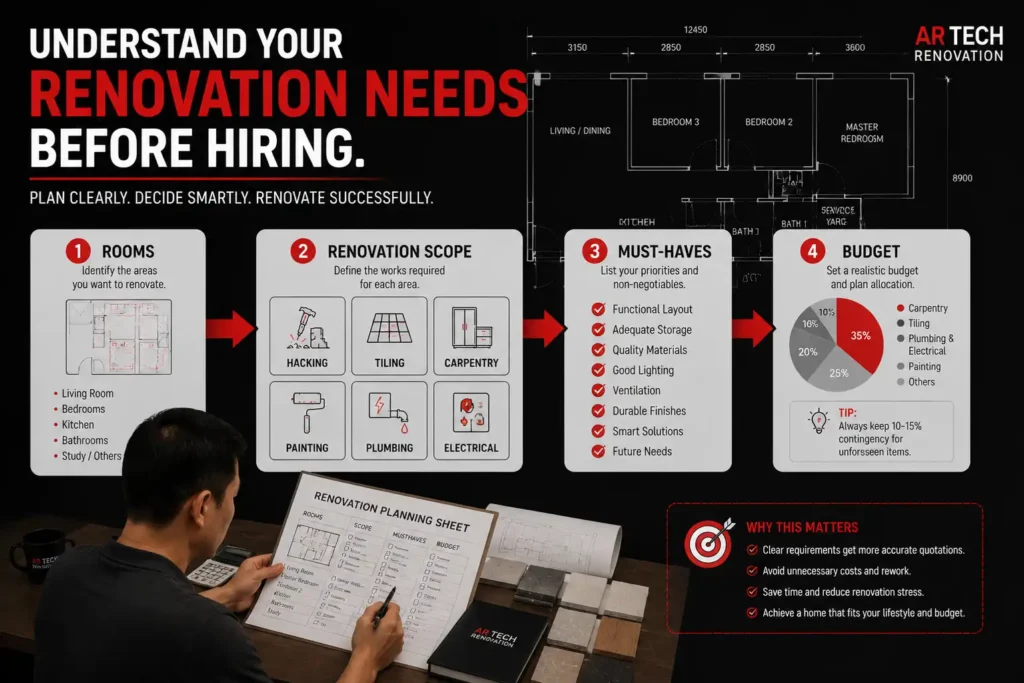
Know what you need before you call a single contractor. This saves time and helps you get accurate quotes. Contractors can’t price work they don’t fully understand – and vague briefs lead to vague answers.
Start by listing everything you want done. Think about which rooms need work, what finishes you want, and what your must-haves are. The clearer your brief, the more useful every conversation becomes.
Define Your Renovation Scope
Your renovation scope is the full list of work you want completed. This includes hacking, tiling, carpentry, painting, plumbing, and electrical work. Write it all down before asking for quotes.
Customers struggle with scope creep. This happens when small add-ons keep growing throughout the project. A clear scope from day one keeps your budget and timeline on track.
Be specific. Instead of saying “redo the kitchen,” list out what you want – new cabinets, countertop material, sink, and flooring. Contractors price based on details, not general descriptions.
Set a Realistic Budget
Set your budget before meeting any contractor, not after. A clear budget helps you compare quotes fairly. It also tells contractors what’s possible so they don’t waste your time.
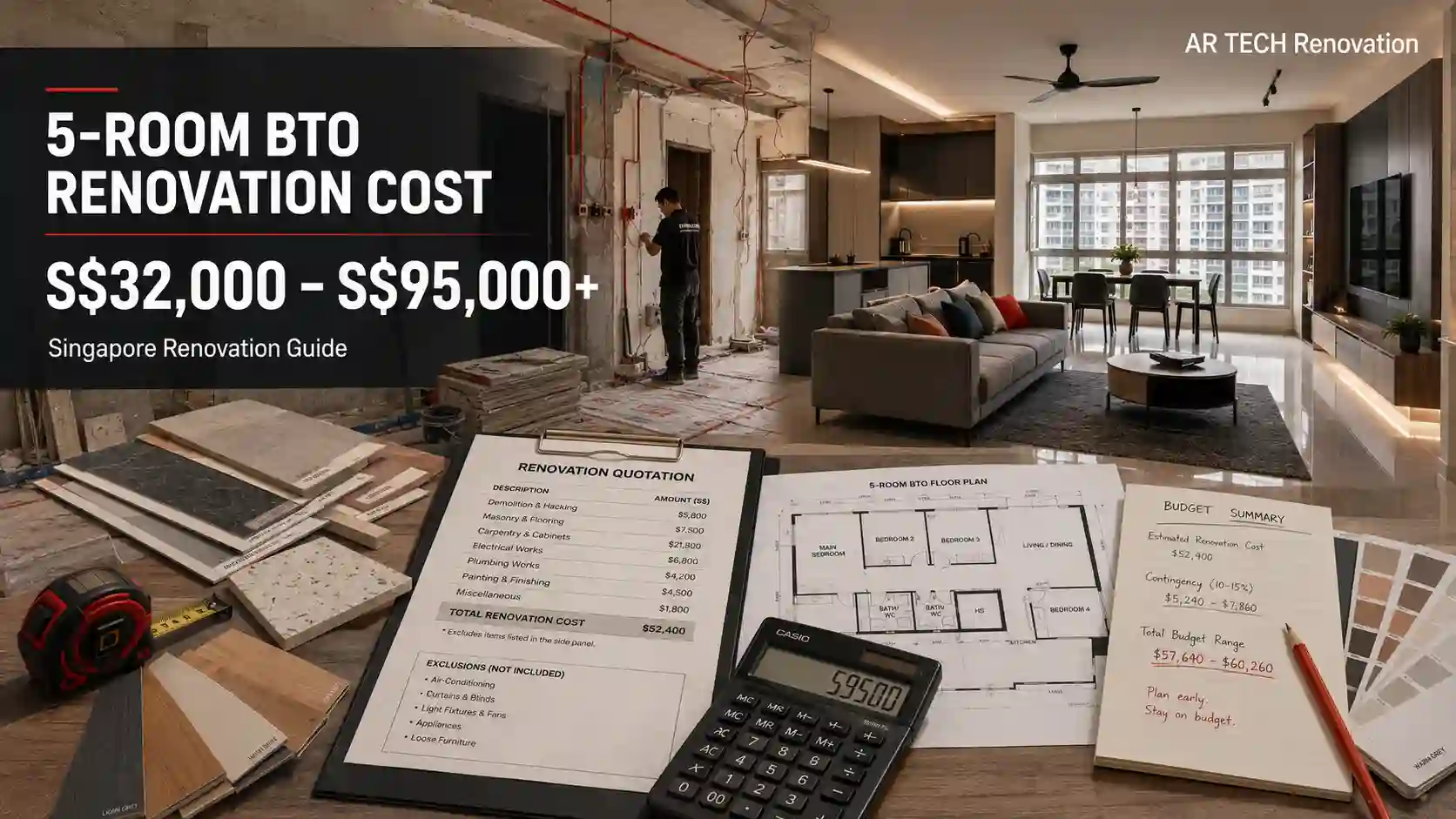
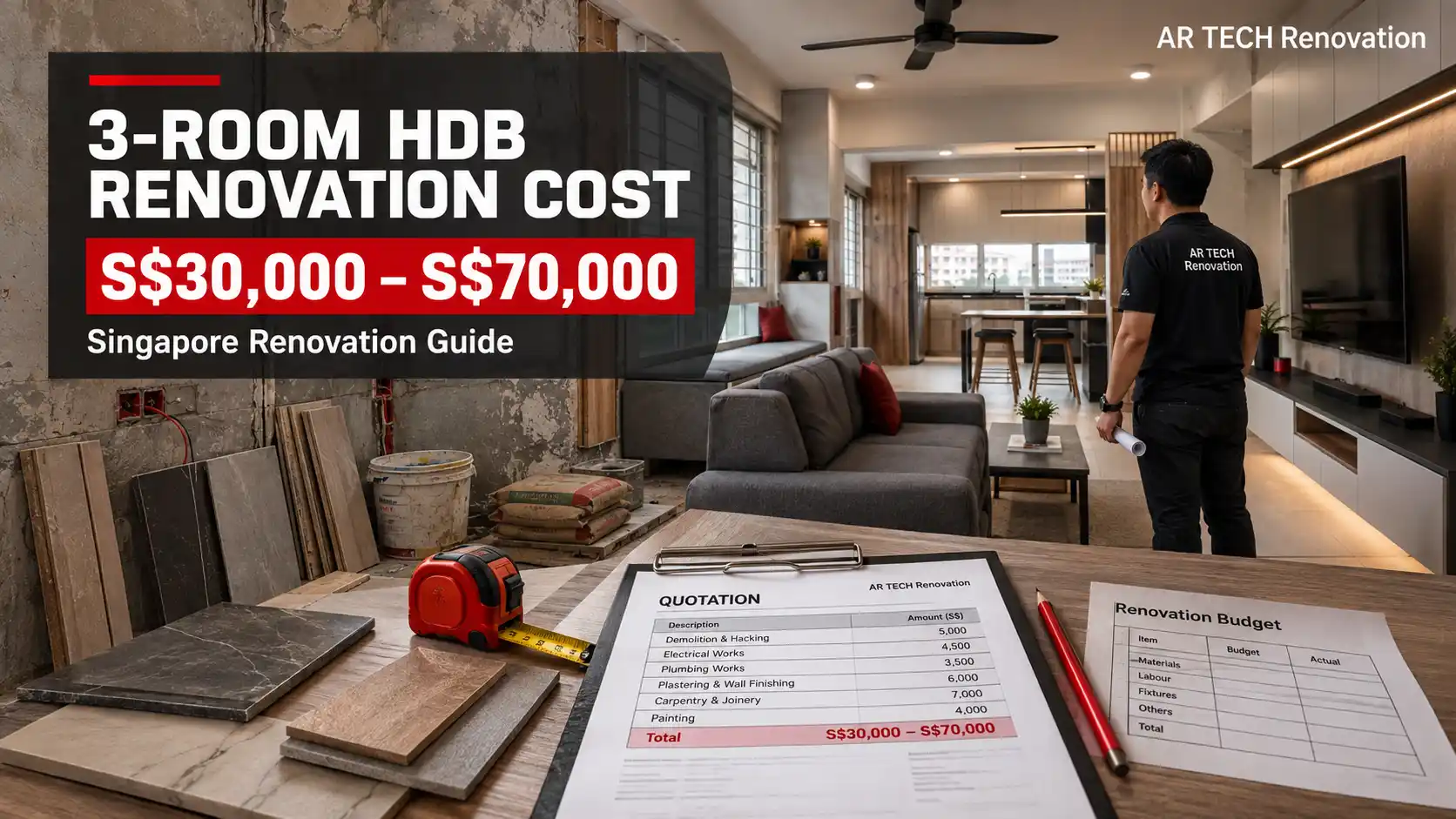
HDB renovation projects in Singapore typically range from $30,000 to $80,000 depending on flat size and work scope. Condo renovations often cost more due to MCST requirements and material choices. Landed home projects vary the most.
Build in a buffer of 10% to 15% for unexpected costs. Hacking old walls sometimes reveals hidden plumbing or wiring issues. These things can’t always be predicted upfront.
Decide Between an Interior Designer and a Renovation Contractor
A renovation contractor and an interior designer do different things. Choose based on what kind of help you actually need. Mixing them up leads to budget surprises.
A main renovation contractor handles construction and installation. They’re the right choice if you already have a design and just need it built. They don’t typically provide space planning or detailed drawings.
An interior designer helps you plan the space, develop the design, produce drawings, and coordinate the project. They charge extra design fees – but they’re worth it if you’re unsure how to lay out your home or want a cohesive look throughout.
Check Credentials and Licensing
Always verify a contractor’s credentials before signing anything. Singapore has clear licensing requirements for renovation work. A contractor without the right licenses puts you at legal and financial risk.
This step takes less than 30 minutes. Most registries are available online. There’s no good reason to skip it.
HDB and BCA Registration
HDB renovation work requires an HDB-registered contractor. If you live in an HDB flat and your contractor isn’t on the HDB Directory of Renovation Contractors (DRC), they cannot legally carry out the work. Check the directory at the HDB InfoWEB before hiring.
The Building and Construction Authority (BCA) registration matters for major structural or heavy civil works. Not every project needs this – but if yours involves structural changes, check for BCA registration too.
CaseTrust Accreditation
CaseTrust accreditation gives you real consumer protection. CaseTrust-accredited renovation firms use standard contracts and offer deposit protection under the relevant consumer-protection arrangement. This limits your upfront deposit to a maximum of 20%.
CaseTrust accreditation isn’t legally required. But it signals that the contractor operates transparently and follows fair business practices. It’s a meaningful mark of professionalism.
You can verify CaseTrust accreditation through the Consumers Association of Singapore (CASE) website. Take five minutes to check.
Specialized Licenses
Some renovation work requires specific trade licenses. Electrical work needs an EMA-licensed electrical worker. Air-conditioning installation requires a qualified installer. These aren’t optional requirements – they’re set by Singapore law.
This problem happens when homeowners assume that any contractor can handle any type of work. Always ask which sub-trades will be involved and whether those workers hold the right licenses. A good contractor will answer without hesitation.
Review Portfolios and Track Records
A contractor’s past work tells you more than any sales pitch. Look at real projects, not just curated highlight photos. You want to see quality, consistency, and experience with properties similar to yours.
This step filters out contractors who look good on paper but can’t execute. Take the time to dig deeper.
Past Projects
Ask to see completed projects similar to your property type. If you own an HDB BTO, look for HDB BTO projects. If you own a condo, ask to see condo work. Materials, finishes, and regulations differ across property types.
Request before-and-after examples with full case studies. Good contractors can show you the starting condition of the space, the materials used, and the completed result. Vague portfolio photos with no context are a warning sign.
If possible, visit an active renovation site managed by the contractor. This lets you assess workmanship quality, site safety, and cleanliness – all signs of how a contractor actually operates day to day.
Independent Feedback
Check reviews from sources the contractor doesn’t control. Google Reviews, HardwareZone forums, and Facebook community groups are good starting points. Look for feedback on communication, workmanship quality, and whether the project finished on schedule.
Pay attention to how contractors respond to negative reviews. A professional response shows accountability. Defensive or dismissive replies are a red flag.
Don’t rely only on testimonials on the contractor’s own website. Those are self-selected. Independent feedback gives you a more honest picture.
Questions to Ask Before Hiring a Renovation Contractor
The right questions reveal a contractor’s experience, professionalism, and reliability. Don’t skip this step. A contractor who can’t answer clearly during the sales stage won’t communicate better once the project starts.
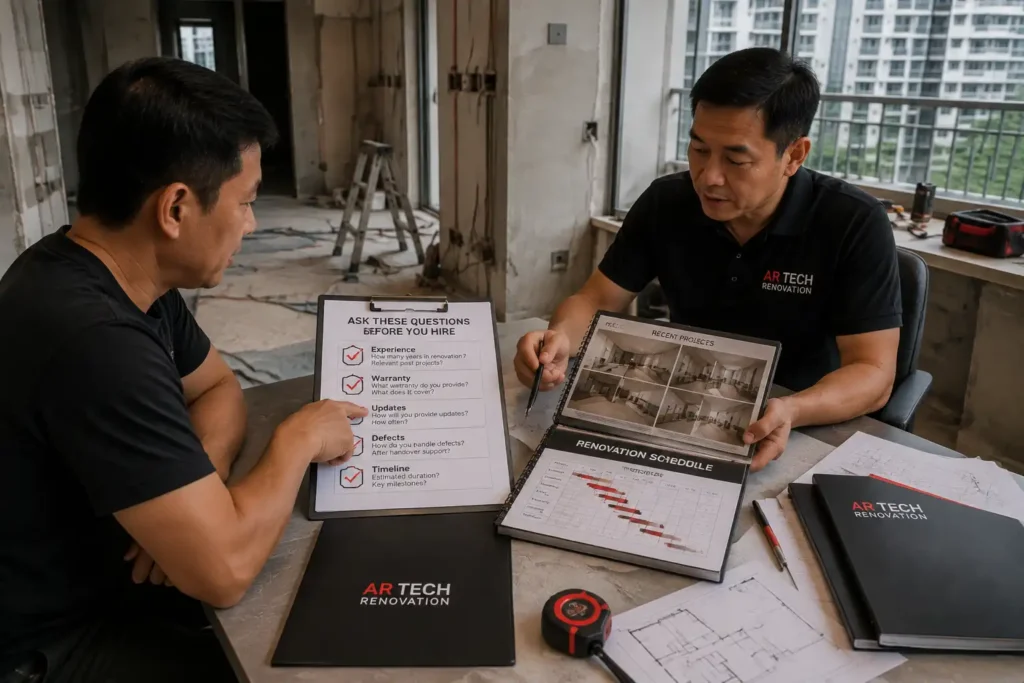
Ask questions before you sign anything. Their answers tell you a lot.
Experience With Similar Projects
Ask directly how many projects similar to yours they’ve completed. This isn’t a rude question – it’s a basic due diligence check. An experienced contractor will answer confidently with examples.
Ask about their experience with your flat or unit type. HDB BTO, resale HDB, condo, and landed homes all have different renovation rules, materials, and logistical considerations. You want someone who knows your property type well.
Warranty and After-Sales Support
Ask what warranty they offer on workmanship and materials. A reliable contractor stands behind their work. Know the warranty period before you sign – not after something goes wrong.
Ask how defects are handled after project handover. Who do you contact? How long does a response take? What’s the process? You want clear answers, not vague reassurances.
Communication and Project Updates
Ask how they’ll keep you updated during the renovation. Will you get weekly progress updates? Who is your main point of contact? How do they handle unexpected problems?
Poor communication causes many renovation disputes in Singapore. You should know upfront how decisions get made and how changes to the original plan are handled. A contractor with a clear process is far less likely to cause you stress.
Compare Quotes and Contracts
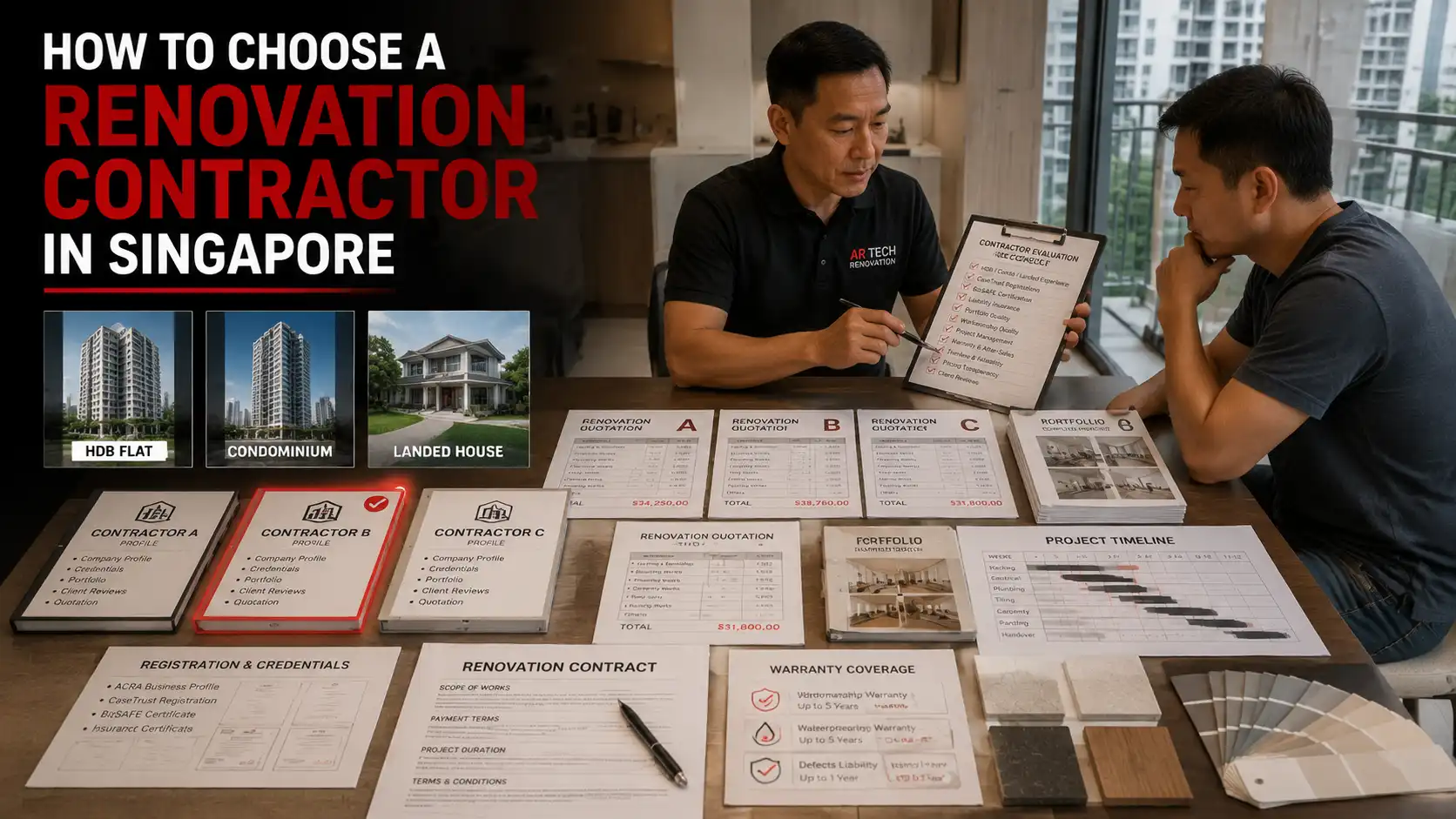
Getting multiple quotes is the most important step before signing. Three quotes give you a realistic price range. One quote tells you nothing. Two quotes leave too much uncertainty.
Don’t compare prices alone. Compare scope, materials, timelines, and payment terms too.
Line-by-Item Breakdown
A reliable contractor provides an itemized quotation – not a lump sum. Every trade should be listed separately. This includes hacking, masonry, tiling, carpentry, plumbing, electrical, painting, and any other work involved.
Check the dimensions, materials, and brands listed for each item. Carpentry is where many homeowners get caught out – vague measurements or materials can lead to big differences in what you actually receive.
Avoid quotations with vague “miscellaneous” or “others” charges. These catch-all line items are hard to dispute later and can hide significant additional costs.
Progressive Payments
A fair payment schedule links payments to completed work milestones. You should never pay for work that hasn’t been done yet. Contractors who demand large upfront payments before work begins are a red flag.
For CaseTrust-accredited contractors, the initial deposit is capped at 20% under the relevant consumer-protection arrangement. Check that subsequent payments match completed stages – foundation work, carpentry installation, final handover, and so on.
Verify each stage before releasing the next payment. This gives you leverage and ensures you’re only paying for what’s actually been completed.
Compare Itemized, Transparent Quotations
Use this as a checklist when reviewing quotations side by side. Three detailed, itemized quotes give you the clearest comparison.
What to Check in Every Quotation:
| Item | What to Look For |
| Hacking and disposal | Listed separately with unit price |
| Masonry and tiling | Dimensions, tile brand, and laying pattern specified |
| Carpentry | Measurements, material type, and brand clearly stated |
| Plumbing | Fixtures, brands, and scope of installation confirmed |
| Electrical | Conducted by EMA-licensed worker, points specified |
| Painting | Number of coats, paint brand, and coverage area |
| Air-conditioning | Installer qualifications and brand confirmed |
| Miscellaneous | No vague catch-all charges – everything itemized |
| Timeline | Each phase with estimated start and end date |
| Payment schedule | Tied to completion milestones, not arbitrary dates |
Compare each contractor against these points – not just the final total. A lower quote with missing details often costs more in the end.
Red Flags to Watch Out For
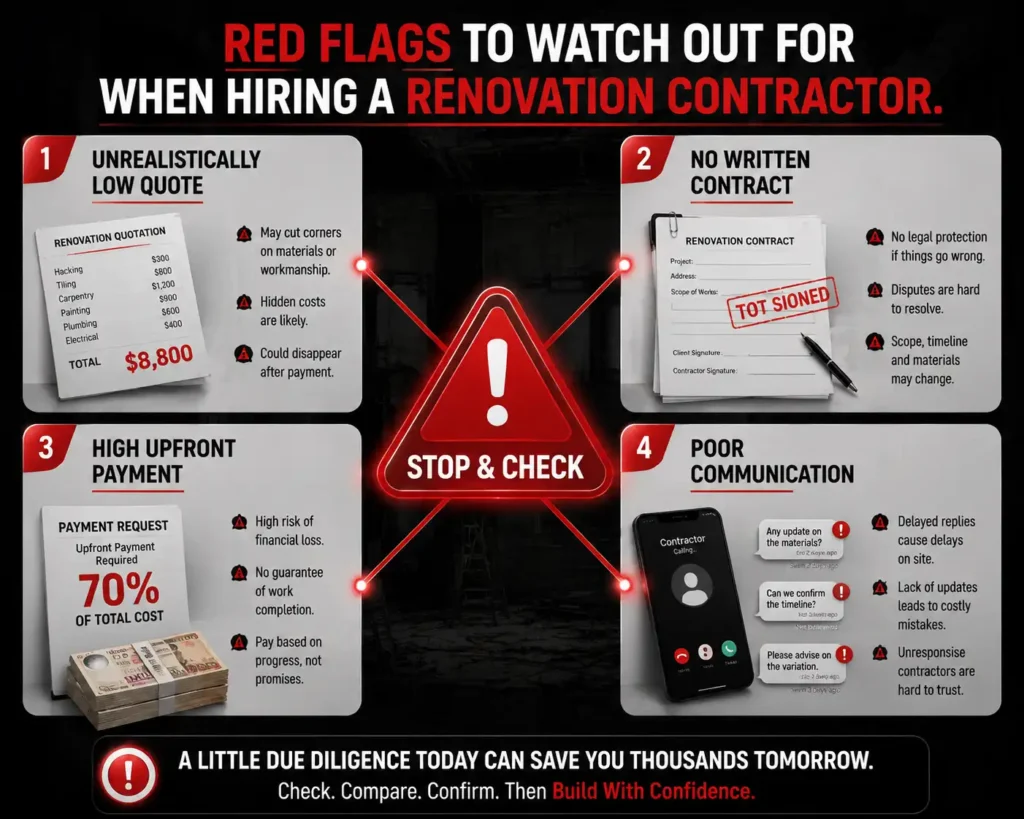
Some warning signs appear early – if you know what to look for. Spotting them before you sign protects your money and your home. Ignore them and you may spend months fixing someone else’s mistakes.
Trust your instincts. If something feels wrong, it usually is.
Unrealistically Low Quotes
A quote that’s significantly cheaper than the others is a warning sign, not a bargain. Some contractors cut quotes to win the job and then add costs later. Others cut corners on materials or workmanship to protect their own margins.
When a quote looks too good, ask what’s missing. Check every line item against the other quotes. Find out which materials are specified. A low price with full details is possible – a low price with vague details rarely ends well.
No Written Contract
Never start renovation work without a signed written contract. A verbal agreement or simple WhatsApp message won’t protect you if something goes wrong. This is non-negotiable.
The contract must clearly define the renovation scope, materials, timeline, payment stages, and how changes are handled. Any contractor who resists putting things in writing is someone you should walk away from.
High Upfront Payment Requests
Be cautious of any contractor who asks for more than 20% upfront. Large upfront payments give contractors little reason to complete the work on time or to your standard. This is one of the most common ways homeowners lose money.
For CaseTrust-accredited firms, the 20% deposit cap provides direct protection. For non-accredited contractors, negotiate payment terms tied to clear milestones. Never pay in full – or even close to full – before the project is done.
Poor Communication
A contractor who is hard to reach before signing will be harder to reach after. Test response times early. How long do they take to reply? Do they answer your questions directly? Do they follow up when they say they will?
Communication problems cause more renovation disputes than almost anything else. You spend weeks or months with this contractor in your home. Choose someone who communicates clearly and consistently from day one.
Frequently Asked Questions
How do I choose a reliable renovation contractor in Singapore?
Check their HDB or BCA registration, review past projects, and compare at least three itemized quotations. Look for contractors with CaseTrust accreditation for added consumer protection. Read independent reviews from Google or renovation forums. Ask questions about their experience, warranty, and communication process before signing any contract.
What qualifications should a renovation contractor have?
The required qualifications depend on the type of work involved. For HDB flats, the contractor must be listed in the HDB Directory of Renovation Contractors. Electrical work requires an EMA-licensed electrical worker. Air-conditioning installation requires a qualified installer. For major structural work, check for BCA registration.
Should I hire an HDB-registered contractor for all renovation projects?
HDB registration is required for renovation work in HDB flats. If you own a condo or landed home, HDB registration isn’t mandatory – but other licenses may apply depending on the scope of work. Always check which licenses apply to your specific property type and renovation scope.
Is CaseTrust accreditation mandatory for renovation contractors?
CaseTrust accreditation is not legally required, but it offers meaningful protection. Accredited firms follow fair business practices, use standard contracts, and operate under a consumer-protection arrangement that caps deposits at 20%. It’s a practical way to reduce your risk when hiring.
How many renovation quotations should I compare before deciding?
Get at least three detailed, itemized quotations. One quote gives you no reference point. Three quotes show you the realistic price range and let you compare scope, materials, and timelines – not just the final number.
What should be included in a renovation quotation?
A proper quotation should list every trade separately with dimensions, materials, and brands specified. This includes hacking, tiling, carpentry, plumbing, electrical, painting, and air-conditioning where applicable. The quotation should also include the project timeline, payment milestones, and a clear note on what’s excluded from the scope.
How much deposit should I pay a renovation contractor?
The standard initial deposit should not exceed 20% of the total project cost. For CaseTrust-accredited contractors, this 20% cap is a formal consumer-protection requirement. For non-accredited contractors, negotiate a lower upfront payment and link subsequent payments to completed milestones.
What questions should I ask before signing a renovation contract?
Ask about their experience with your property type, their warranty terms, and how they handle project updates. Also ask who manages your project on-site, how they handle unexpected cost increases, and what happens if the project runs behind schedule. These questions reveal how professional and transparent the contractor really is.
What are the warning signs of an unreliable renovation contractor?
Key red flags include unusually low quotes, no written contract, and requests for large upfront payments. Other warning signs include vague quotations with “miscellaneous” charges, poor communication during the inquiry stage, no verifiable past projects, and no HDB registration for HDB work. If a contractor pushes you to sign quickly or discourages you from comparing quotes, walk away.
Conclusion
Choosing the right renovation contractor in Singapore comes down to three things: verifying credentials, reviewing real work, and getting everything in writing. Check HDB and CaseTrust registration. Compare at least three itemized quotations. Link every payment to completed milestones. These steps protect your budget and your home.
Singapore Home Renovation Services has helped hundreds of homeowners through this exact process. We hold all required registrations, provide fully itemized quotes, and keep you updated throughout every phase. Our work speaks through completed projects – not just promises.
Ready to start your renovation the right way? Contact us today for a free, detailed quotation. We’ll walk you through every step – so you can make a confident, informed decision before signing anything.