Most homeowners in Singapore don’t realise they need a permit before they start renovating. You plan the design, pick a contractor, then discover you can’t begin legally without approval. This is more common than you think – and it can delay your project by weeks.
Getting caught without the right permits is costly. You may face fines, forced demolition, or disputes with your neighbour or management. Knowing what approvals you need upfront saves time, money, and stress.
This guide covers everything you need to know. You’ll learn which works need permits, how to apply, how long approval takes, and what rules apply to your property type – whether you live in an HDB flat, condominium, or landed home.
What Counts as a Renovation Permit?
A renovation permit is an official approval to carry out specific building works. Not every renovation needs one. But any work that changes the structure, layout, plumbing, or electrical system usually does.
This problem happens when homeowners assume small changes are always permit-free. Removing a wall feels minor. But if it involves any structural element or changes the floor plan, you need approval. The permit ensures the work is safe and follows Singapore’s building rules.
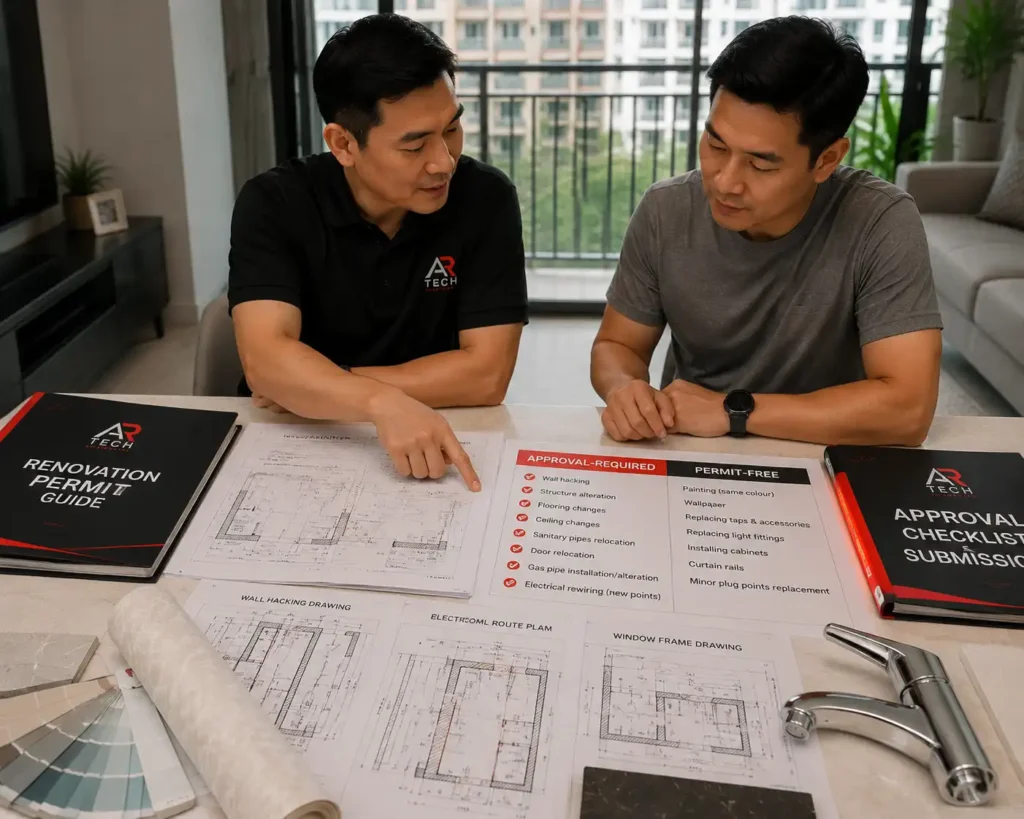
Works that typically need a permit include hacking walls, changing bathroom layouts, altering electrical lines, and replacing window frames. Works that don’t usually need one include repainting, installing wallpaper, and changing tap fittings without moving pipes.
Regulatory Bodies and Property Types
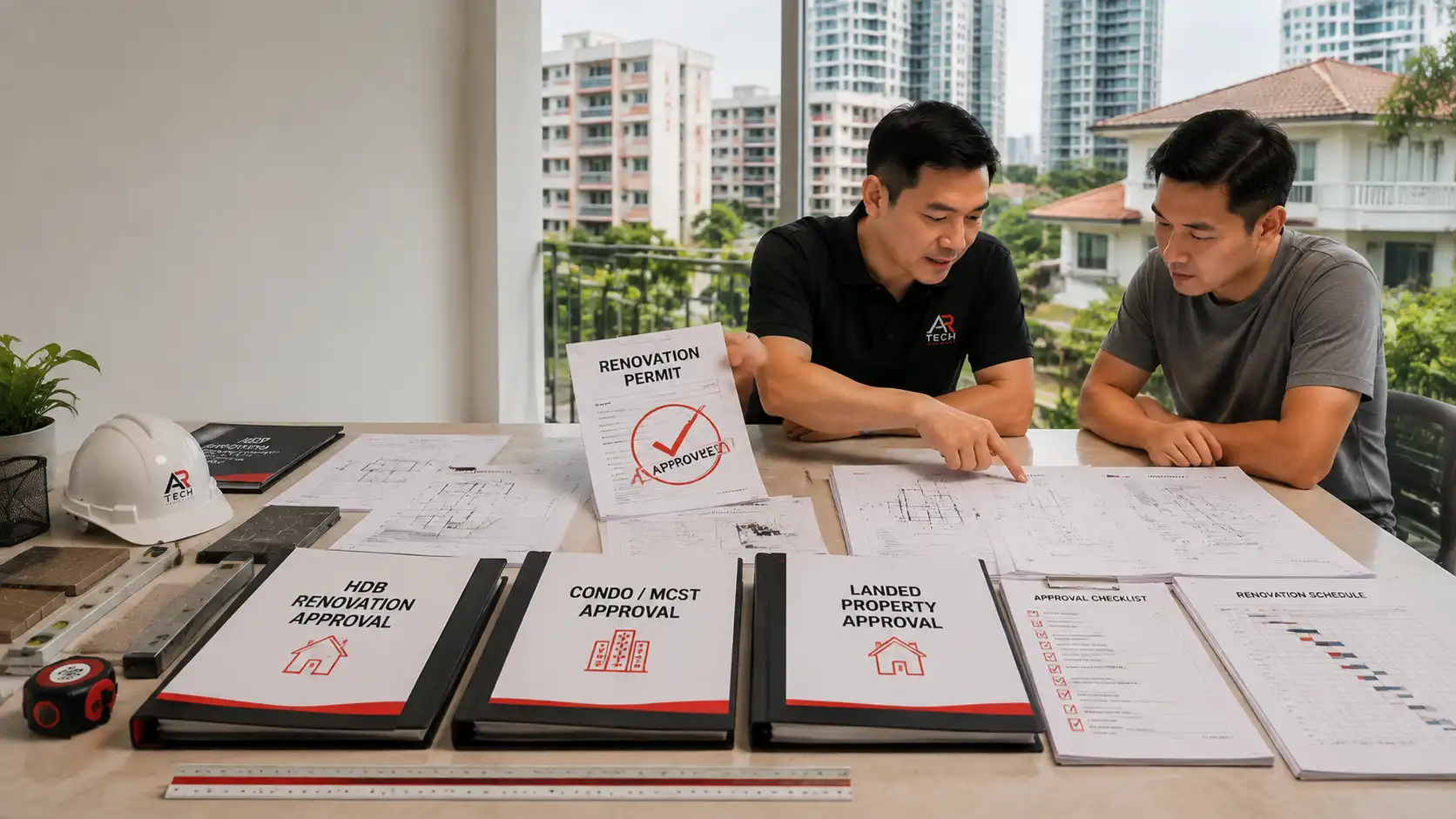
Different authorities oversee renovations depending on your property type. Here is a clear overview:
| Property Type | Governing Body | Key Requirement |
| HDB Flat | Housing & Development Board (HDB) | Registered DRC contractor must submit plans |
| Private Condominium | Management Corporation Strata Title (MCST) | MCST approval before works begin |
| Landed Property | Building & Construction Authority (BCA) / Urban Redevelopment Authority (URA) | Formal submissions for structural or envelope changes |
| All Electrical Works | Energy Market Authority (EMA) | Licensed Electrical Worker (LEW) required |
| All Plumbing Works | Public Utilities Board (PUB) | Must comply with PUB requirements |
Knowing which body governs your home is the first step. Each has its own rules, timelines, and documentation requirements.
HDB Flat Regulations and Permits
HDB has detailed renovation rules to protect the structural integrity of public housing blocks. These rules apply to all flats – new or old, big or small.
Customers often struggle with knowing where to start. The good news is that your contractor handles most of the submission process for you. But you still need to understand what’s allowed and what’s not before signing any contract.
Works That Require Permits
These HDB works need an approved permit before starting:
- Removing non-structural partition walls
- Replacing floor finishes where hacking is needed
- Changing bathroom layouts
- Altering plumbing or pipe routes
- Altering electrical lines
- Replacing complete window frames or grilles
- Replacing certain main entrance doors along shared exit routes
Any of these done without approval can result in penalties and forced restoration.
Works That Don’t Require Permits
Some renovations are permit-free and can start without HDB approval. These include interior painting, installing wallpaper, fitting non-structural built-in wardrobes, and changing sink taps without moving pipes.
This list is shorter than most homeowners expect. When in doubt, check with your contractor before assuming a job is permit-free.
One important note: newly built BTO bathrooms have a 3-year restriction on hacking or removing existing floor and wall finishes. This protects the original waterproofing system. Do not hack BTO bathroom tiles within this period.
Contractor Rule
All HDB renovation works must use a contractor from the HDB Directory of Renovation Contractors (DRC). You cannot hire just any contractor. They must be registered with HDB.
This rule protects you. Registered contractors know the rules. They submit the correct plans and take responsibility for the works. Hiring an unregistered contractor puts your flat – and your money – at risk.
Renovation Hours
HDB renovation is only allowed during specific hours. General renovation runs from 9:00 AM to 6:00 PM, Monday to Saturday. No renovation is allowed on Sundays or public holidays.
Noisy works – like drilling and heavy hacking – are only allowed from 9:00 AM to 5:00 PM on weekdays. Heavy hacking and drilling are not allowed on Saturdays. Heavy hacking is also limited to 3 consecutive days maximum under HDB rules.
These hours protect your neighbours. Breaching them can lead to complaints and enforcement action.
Time Limits
HDB sets clear deadlines for completing renovation once a permit is issued. For new blocks, you must finish within 3 months of permit issuance. For existing blocks, the limit is 1 month. Window-only works may have shorter completion periods.
These limits are strict. Plan your renovation carefully to avoid permit lapses.
Condominium Regulations
Private condominium renovations require approval from the development’s Management Corporation Strata Title (MCST). This applies even if the works seem minor. Every condominium has its own set of building by-laws.
Customers struggle with the fact that condo rules vary widely. What is allowed in one condo may not be allowed in another. Always request a copy of your condominium’s renovation guidelines before planning your works.
MCST Approval
You must submit your renovation plans to the MCST before starting any work. The MCST reviews the plans to ensure they follow the development’s building rules. Structural changes may also require a Professional Engineer (PE) endorsement. Major structural modifications may need formal BCA approval.
Your contractor should prepare the submission documents. But you, as the owner, are responsible for getting approval. Starting without MCST approval can result in stop-work orders or penalties.
Working hours for condo renovations are set by each individual condominium’s management – not by a single universal rule. Check your condo’s specific hours before scheduling works.
Deposits and Rules
Most condominiums require a refundable renovation deposit before work begins. This deposit covers any damage to common areas caused during renovation. The amount varies by development.
Contractors must follow the specific renovation rules of the development. This includes rules on debris disposal, material delivery times, and lift protection. Make sure your contractor understands and agrees to these rules before work starts.
Landed Property Regulations
Landed property renovations can involve multiple regulatory submissions depending on the scope of work. Simple internal works may not require much. But structural changes or extensions involve more steps.
This is where many homeowners underestimate the complexity. Even adding a small extension or modifying the roofline can trigger formal regulatory requirements.
BCA Submissions
Structural building works on landed properties may require BCA approval. This includes changes to load-bearing elements, floor structures, and major additions or alterations (A&A works). Major building submissions may be processed through the CORENET-X system.
Not every landed renovation needs BCA approval. But any works that affect the structural integrity of the building will. Your contractor or qualified professional can advise you on this.
Qualified Person
A Qualified Person (QP) – an architect or engineer – must oversee significant renovation works on landed properties. They prepare and submit the required technical documents to BCA and URA.
Changes to the property’s external envelope, footprint, or Gross Floor Area (GFA) may require URA approval. This applies to extensions, new rooms, and any work that changes the building’s size or shape. Engage a QP early to avoid design changes later.
Step-by-Step Permit Application Process
The permit application process varies by property type, but follows a similar overall flow. Here is how it typically works for most Singapore homeowners.
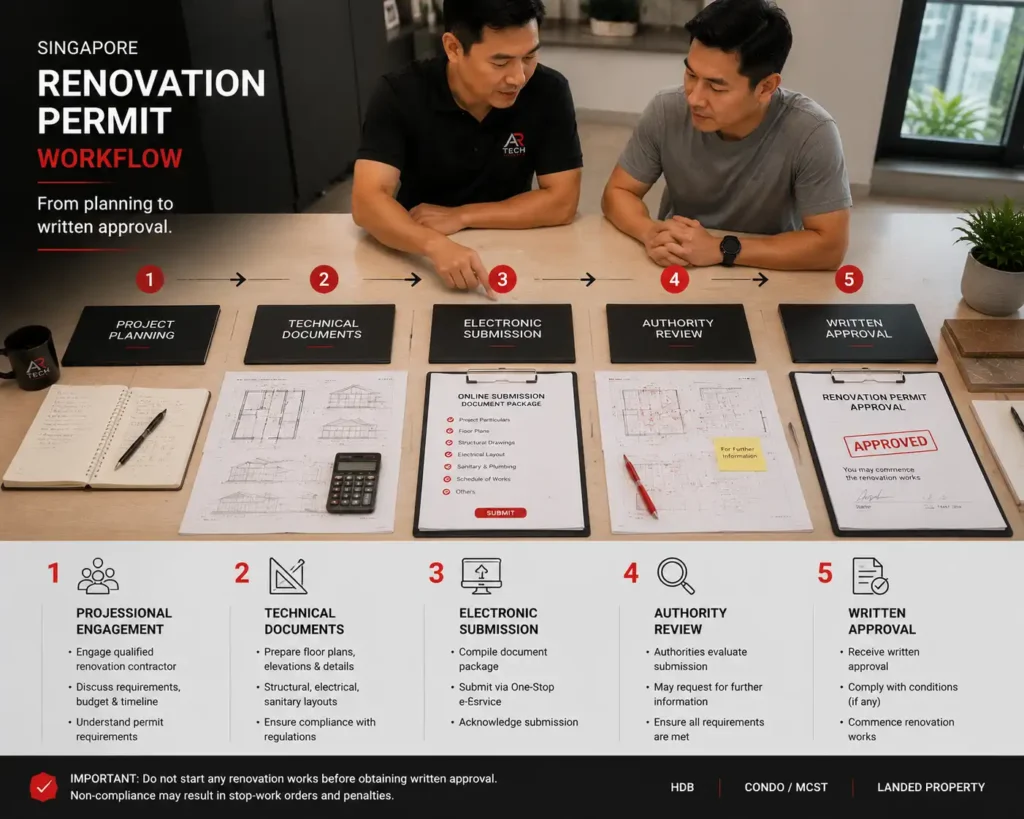
Step 1: Engage an Accredited Professional
Start by engaging a contractor or professional who is authorised to apply for permits. For HDB, this means a DRC-registered contractor. For landed properties, this means a Qualified Person such as an architect or structural engineer.
Do not start designing works until you know who is responsible for the submission. This is the foundation of a smooth permit process.
Step 2: Compile Technical Documentation
Your contractor or QP will prepare the required plans and technical documents. This typically includes floor plans, proposed changes, structural drawings (if needed), and supporting endorsements.
For structural works, a structural engineer’s endorsement may be required. Gather all documents before submission. Incomplete submissions cause delays.
Step 3: Electronic Submission
HDB renovation plans are submitted electronically through HDB’s online system. Landed property submissions may go through CORENET-X. Condo plans are submitted directly to the MCST.
Your contractor handles this step. You review and confirm the submission is accurate before it goes in.
Step 4: Approval Turnaround
Standard HDB applications typically take around 3 to 7 working days. Applications that need structural engineer endorsements take longer. MCST approval timelines vary by development. Landed property BCA submissions depend on the complexity of the works.
Plan your renovation schedule with these timelines in mind. Never book workers or order materials before you receive written approval.
Frequently Asked Questions
Do I need a permit for every home renovation in Singapore?
No, not every renovation in Singapore requires a permit. Simple works like repainting walls, installing wallpaper, or changing tap fittings without moving pipes are generally permit-free. But works involving hacking, structural changes, plumbing rerouting, or electrical alterations usually need formal approval. The property type also matters – HDB, condo, and landed homes each have different rules.
What renovations require an HDB permit?
HDB permits are required for works like hacking non-structural partition walls, changing bathroom layouts, altering plumbing or electrical lines, replacing complete window frames, and replacing certain main entrance doors. These works affect the flat’s structure, safety, or shared building systems. Your DRC-registered contractor submits the permit application on your behalf through HDB’s system.
Do condominium renovations need MCST approval?
Yes, all condominium renovations require MCST approval before work starts. The MCST reviews renovation plans to ensure they follow the development’s building by-laws. Major structural changes may also need a Professional Engineer (PE) and possibly BCA approval. Each condominium sets its own specific rules and renovation hours.
Who can apply for renovation permits?
For HDB flats, only a contractor registered in the HDB Directory of Renovation Contractors (DRC) can submit the permit application. Homeowners cannot submit directly. For landed properties, a Qualified Person – such as a licensed architect or engineer – handles formal regulatory submissions. For condominiums, the contractor or owner submits renovation plans to the MCST.
How long does it take to get renovation approval?
Standard HDB renovation applications typically take around 3 to 7 working days. Applications requiring structural engineer endorsement take longer. MCST approval timelines vary by condominium. BCA approvals for landed properties depend on the scope and complexity of works. Always apply early and factor approval time into your renovation schedule.
What time is renovation allowed in Singapore?
General renovation is allowed from 9:00 AM to 6:00 PM, Monday to Saturday. Noisy works like drilling are restricted to 9:00 AM to 5:00 PM on weekdays only. Heavy hacking and drilling are not allowed on Saturdays. No renovation is allowed on Sundays or public holidays. Heavy hacking is also limited to 3 consecutive days under HDB rules.
Can I renovate without obtaining the required permits?
No. Starting regulated renovation works without the required permits is a serious violation. For HDB flats, this can result in enforcement action, fines, and mandatory restoration at your own cost. For condominiums, unpermitted works can lead to stop-work orders and forfeiture of your deposit. The risk is not worth it.
What happens if I violate renovation regulations?
Violating renovation regulations can result in penalties, stop-work orders, and mandatory reinstatement of the original condition. For HDB flats, you may be required to hack out completed works and restore the flat at your own expense. Structural violations can also affect the safety of your home and neighbouring units. Enforcement is taken seriously in Singapore.
Can I complain about renovation noise?
Yes, you can report excessive renovation noise to the relevant authorities. For HDB estates, you can contact the HDB Branch Office or the National Environment Agency (NEA). For condominiums, report to your MCST management office first. If renovation is happening outside permitted hours, document the time and nature of the noise before filing a complaint.
Conclusion
Home renovation permits in Singapore are not optional – they protect your home, your neighbours, and your investment. HDB flats, condominiums, and landed properties each have different rules. Knowing which regulations apply to your property helps you plan properly and avoid costly mistakes.
The process is manageable when you work with the right people. A DRC-registered contractor handles HDB submissions. An MCST-approved process covers condominium works. A Qualified Person manages landed property submissions. Each property type has its own approval body, timeline, and documentation requirements.
Singapore Home Renovation Services has guided homeowners through these permit processes for over 10 years. We know the rules, handle the paperwork, and make sure your renovation starts legally and runs smoothly. Reach out to us today – we’ll help you plan your renovation the right way from the very beginning.